Solutions / By size
Job management for small trade businesses finding their feet.
You've grown past one van and a notebook. Now you've got a few sparkies, a couple of subbies and an apprentice asking where they need to be tomorrow. Trak keeps the wheels on while you grow.
No cost per user. No card required.
Where you are right now
You started solo. Maybe one apprentice, maybe a mate helping out on bigger jobs. Spreadsheets worked. The whiteboard in the shed worked. A group chat for the team worked.
Then you grew. Now you've got 2-15 people in some combination of staff, apprentices, casuals and subbies, and the old system isn't holding it together anymore. Jobs are slipping through. The schedule lives in four places: your head, the whiteboard, the calendar, and the WhatsApp group. And they don't agree. Invoices are going out late because admin can't keep up. Margins are thinner than they should be because nobody's really tracking job costs.
You're not a big company. You don't need enterprise software. But you've outgrown the back-of-the-ute approach and you can feel it every week.
Who this is for
Trade businesses in the 2-15 staff range, including any mix of:
- Employed tradies and apprentices
- Office or admin staff (full time or part time)
- Casual labourers
- Regular subcontractors you bring on as needed
You're probably running between 30 and 200 jobs a month. You've got recurring clients, repeat work, and the occasional bigger project. You want to grow, but not at the cost of working every weekend on admin.
What changes when you grow past sole-trader
A few things break that didn't break before:
-
You can't hold everything in your head.
You used to know where every job was up to. Now there are 40 in flight and you're losing track of which ones are quoted, which are scheduled, and which are waiting on parts.
-
Every new person adds chaos before they add capacity.
A new apprentice means more scheduling complexity, more SWMS to sign off, more timesheets to chase, more questions.
-
Subbies need visibility, but not too much.
You want them to see their jobs without seeing your whole client list or your pricing.
-
Margins need active management.
When you were on the tools yourself, you knew if a job was profitable. Now you're a step removed, and unless something tracks costs against revenue per job, the picture gets fuzzy fast.
-
Cash flow gets tighter, not easier.
More people on the books means more wages going out before invoices come in.
This is the size where the right software stops being a nice-to-have and starts being the difference between a business that scales and one that grinds you down.
How Trak fits small trade businesses
You add staff without adding cost.
Trak doesn't charge per user. Bring on a new apprentice, a casual, or a subbie for 2 weeks and your plan doesn't change. Compare that to per-user platforms where every new hire is another $50-$70 a month forever.
Scheduling everyone can see.
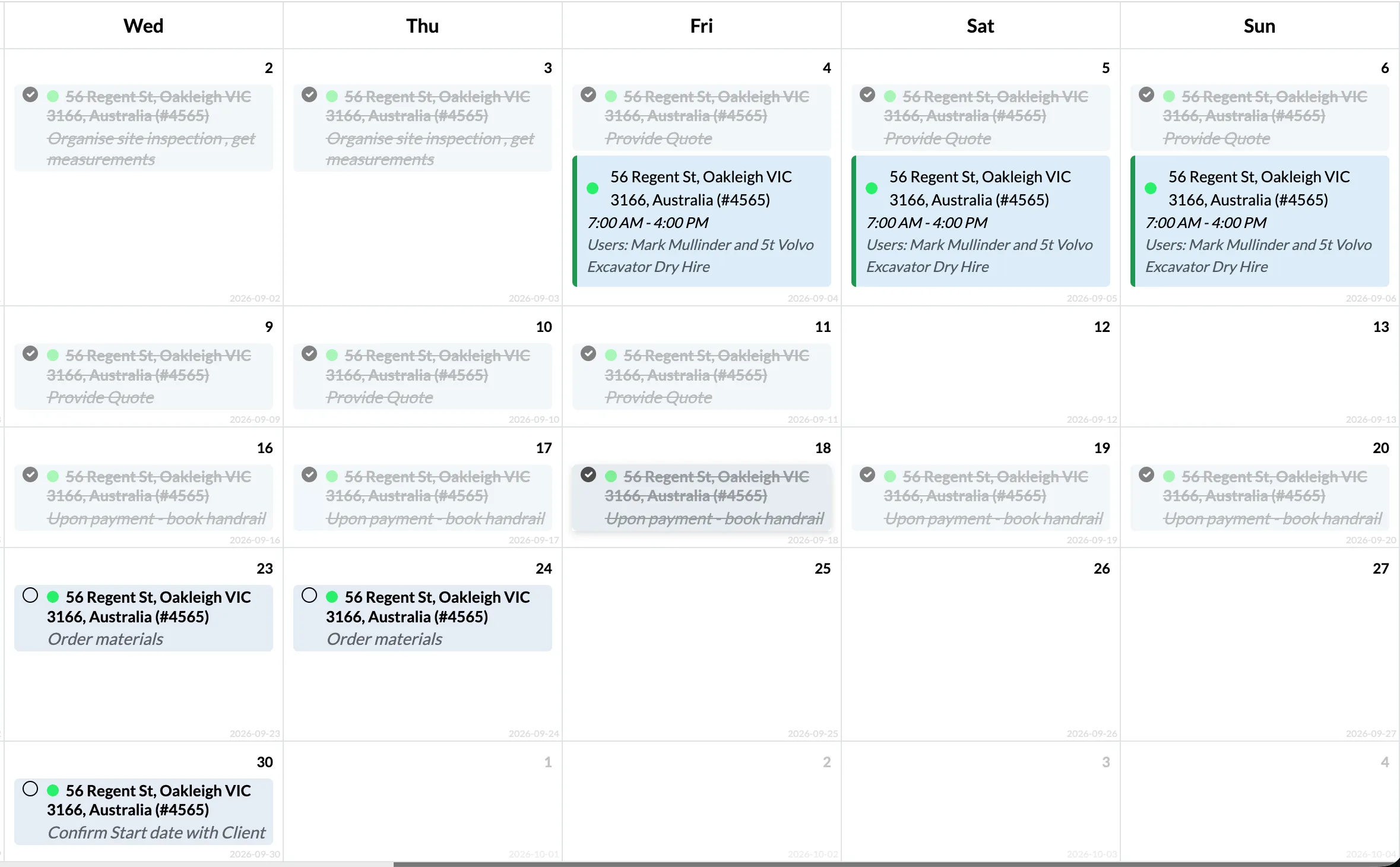
One source of truth for who's on what job, what's next, and what's been done. Drag-and-drop reassignment when something changes. Your team sees their day on their phone; you see the whole week at a glance.
Subbies on the same system, without paying per seat.
A subbie on a job costs you one credit. They get a limited view: their jobs, their schedule, what they need to sign off. They don't see your client database or your margins.
Job costing while the job is running, not after.
Materials, labour, subbie costs and expenses tied to the job as they happen. So you know what's profitable before the invoice goes out, not 3 months later.
Mobile that works on every phone in the crew.
Half your team has iPhones, half has Androids. Both get the full Trak app, not a stripped-down version. Sign-on, SWMS, photos, attachments, invoicing, all on the phone.
Two-way Xero / MYOB / QuickBooks sync.
Quotes, invoices and payments flow into your accounting software automatically. No double entry. Your bookkeeper or accountant sees what they need to see, when they need to see it.
Features that matter most at this size
-
Scheduling
the daily lifeline as the team grows
-
Subcontractor management
bring subbies on without per-user fees
-
Timesheets
captured on the phone, synced to payroll
-
Job costing
know what's profitable before you invoice
-
Quoting
itemised, branded, with parts pricing
-
Mobile app
works on iPhone and Android, identical experience
-
Two-way Xero sync
no double entry, no reconciliation pain
Recommended plan
Most small trade businesses start on Pro.
At this size, you're typically running enough jobs and enough team that the Basic credit model stops making sense, and you start needing the advanced quoting, job profitability tracking, and product bundling that Pro includes. Pro also gives you automations, the small things that quietly save your admin person two hours a week.
If you've got strict compliance requirements (commercial electrical, civil, multi-trade contracting), Premium adds compliance documentation tracking and the AI-driven expense capture that takes another half-day a week out of your admin load.
This isn't a gate. Every plan supports the full team. You can change tiers any time.
Common questions at this size
-
How does pricing work as I add team?
There are no per-user fees. You can add staff, admin, casuals and subcontractors without your plan price changing. You pay per job and per plan tier.
-
Can I see what each job is costing me?
Yes. Materials, labour, subbie costs and expenses are tied to the job as they happen, so you can see profitability per job, not 3 months after the fact.
-
Can my admin person use it without being on the tools?
Yes. Trak supports office-based users with their own permissions and views. Your admin sees the schedule, invoices, and reports without needing to be set up like a field tradie.
-
Will it work for our subbies?
Yes. Subbies get a limited-access view of just their jobs and schedule, and can complete SWMS, sign-offs and photo capture from their own phone. You pay a single credit per subbie job. No per-user fees.
-
How do timesheets work?
Staff complete timesheets on their phone, tied to the right job. Approved timesheets flow into your job costing and out to payroll.
-
How long does it take to set up for a team of 5-10?
Most businesses this size are live and running real jobs through Trak within 2-5 working days, including importing your client list and setting up job types. Our team helps with the setup at no extra cost.
Built for the awkward middle. Too big for spreadsheets, not ready for enterprise software.
No cost per user. Cancel any time. Real humans on chat. Melbourne team of 6.